
Problem

Destiny is a senior capstone mission concept to reach 650 AU and use the Sun as a gravitational lens for deep-space imaging. The design covers spacecraft architecture, trajectory planning, and long-term operations for a 57-year mission.
The plan combines a methalox bipropellant system for early maneuvers with a 410 m × 410 m solar sail for the long cruise. An RTG powers the spacecraft through the decades-long journey, with round-trip communications delayed by over 10 days at the far end.
My Contribution
I led the flight dynamics work, defining the trajectory, validating the mission timeline, and estimating the ΔV needed for each phase.
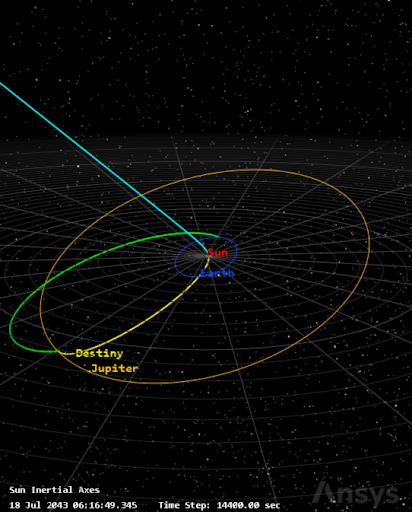
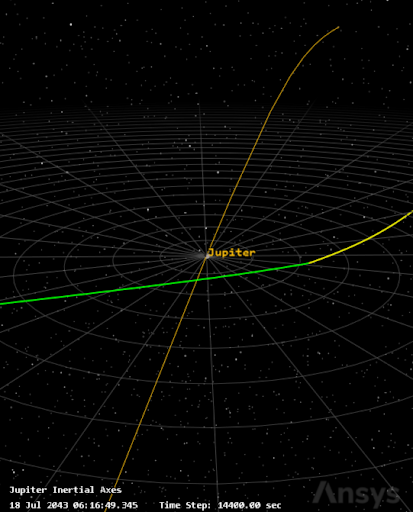
- Trajectory Design — Built the three-leg mission plan in AGI STK Astrogator, including Earth-to-Jupiter, Jupiter gravity assist with plane change, and a Solar Oberth burn.
- ΔV Budget — Estimated 57.7 km/s total ΔV using Lambert solutions, down from a 65 km/s baseline.
- Simulation Setup — Configured Sun-centered STK scenarios with gravity, solar radiation pressure, and perturbation models for long-term propagation.
- Timeline Planning — Mapped the mission from launch in 2049 through imaging operations at 650–900 AU after 2096.
- Orbital Analysis — Evaluated Jupiter assist effectiveness, Solar Oberth dynamics, and long-duration coast segment stability.
- Verification — Checked maneuver sequences and convergence, and coordinated requirements with propulsion and thermal teams.
- MATLAB Support — Created a flight dynamics calculator for initial architecture estimates.
Approach
Trajectory design
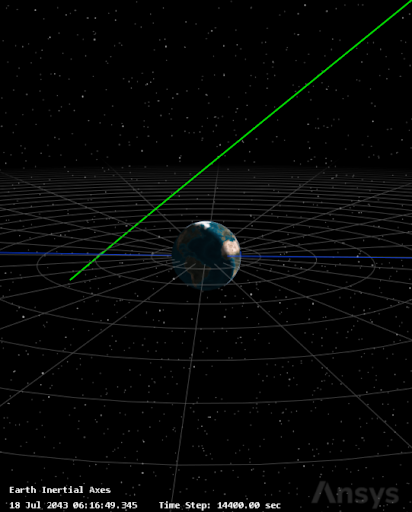
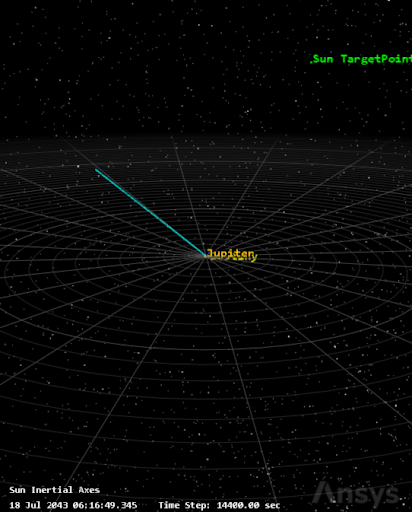
The mission was modeled in a Sun-centered STK Astrogator scenario with three sequential legs: Earth to Jupiter, Jupiter to the Sun, and Solar Oberth escape to 650 AU.
ΔV budget
Initial transfer solutions were generated with STK’s Lambert Solver, which estimates the velocity changes needed for each leg.
Tools & methodology
STK Astrogator was used for high-fidelity propagation, maneuver targeting, and visualization.
- Force models: solar gravity, solar radiation pressure, relativistic perturbations
- Maneuver targeting with differential correctors and Lambert solvers
- Constraint solving for mission legs and rendezvous conditions
- Visualization in heliocentric, Jupiter-centric, and solar-centric frames
Result
STK trajectory images show key mission phases from launch through Solar Oberth escape to 650 AU.
Mission schedule
Jupiter’s 11.86-year window drives the mission timing. The schedule spans mission development, launch, key maneuvers, and the long cruise to the focal region.
Current status
The current model optimizes each leg independently, so it does not yet guarantee the final trajectory is aimed precisely at anti-Proxima Centauri b. The overall architecture is promising, but end-to-end optimization remains to be completed.
Final presentation
Code
The project code and documentation are available on GitHub. The final paper covers the Destiny mission design, flight dynamics, operations, and spacecraft architecture — the sections I wrote are I.D, XII, XIII.A.3, and the code reproducibility Flight Dynamics section.
GITHUB REPOSITORYwyattowelch/AE460-Solar-Gravitational-LensVIEW REPOSITORY →